Central government employees and pensioners across India are closely following every development around the 8th Pay Commission. With the 7th Pay Commission’s term drawing to a close, questions around the fitment factor, expected salary hike, and the commission’s formation timeline are on everyone’s mind. In this article, we break down where things currently stand — in plain, easy-to-understand language.
What Is the 8th Pay Commission?
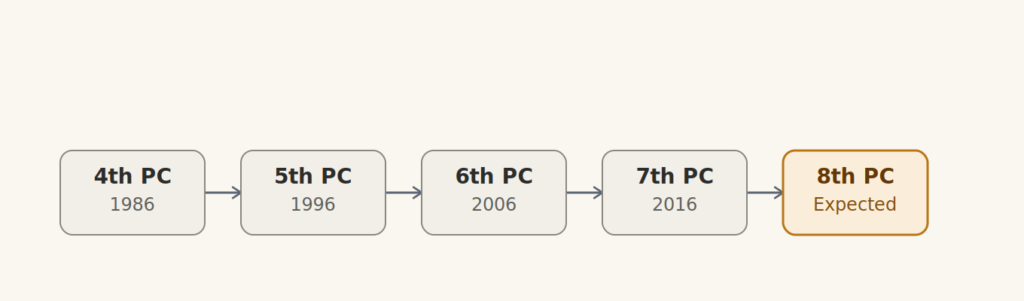
The Pay Commission is a body set up by the Government of India, roughly once every ten years, to review and recommend changes to the salary structure, allowances, and pension benefits of central government employees. The 8th Pay Commission is the next expected revision after the 7th Pay Commission, which came into effect in January 2016.
Its recommendations typically influence basic pay, dearness allowance (DA), house rent allowance (HRA), and pension calculations for lakhs of employees and retirees.
Latest Updates on the 8th Pay Commission (July 2026)
Where the Government Stands
As of now, the government’s official position on formally constituting the 8th Pay Commission is still awaited. While demands have been raised in Parliament and through employee associations, no formal notification regarding the chairperson or terms of reference has been released yet.
What Employee Unions Are Demanding
Various central government employee unions have already started submitting their charter of demands. A major point of discussion is the fitment factor — the multiplier used to calculate revised basic pay from the current pay structure. Some unions have pushed for a higher fitment factor compared to earlier estimates, citing rising inflation and cost of living.
Expected Fitment Factor: What Are the Estimates?
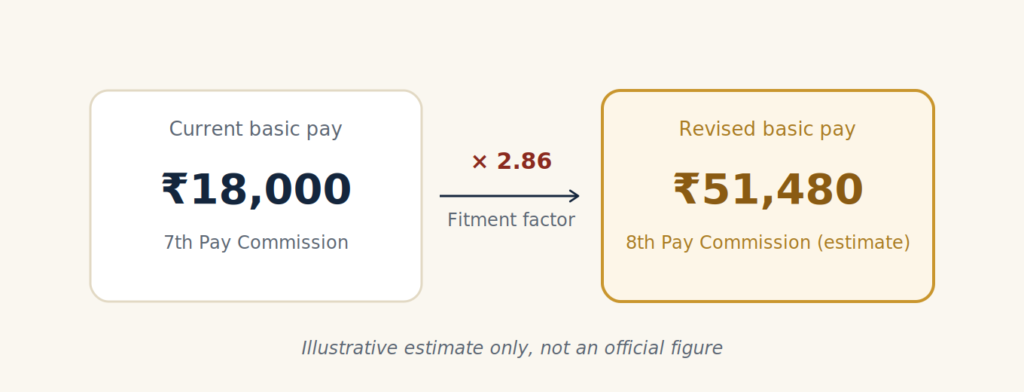
The fitment factor is one of the most talked-about numbers in any pay commission cycle. Under the 7th Pay Commission, the fitment factor was set at 2.57, which raised the minimum basic pay from ₹7,000 to ₹18,000.
For the 8th Pay Commission, various estimates currently under public discussion range between 2.57 and 2.86, though nothing has been officially confirmed. A higher fitment factor would mean a bigger jump in basic pay, while a factor closer to the previous cycle would mean a more modest increase.
How the Fitment Factor Affects Your Salary
Here’s a simple way to understand it: if your current basic pay is ₹18,000 and the fitment factor applied is 2.86, your estimated revised basic pay would be approximately ₹51,480. This is purely illustrative — the actual figure will depend on the final factor the government approves.
Expected Salary Hike Under the 8th Pay Commission
While no official numbers exist yet, illustrative comparisons help employees understand the possible scale of change. For example, at a proposed 2.86x fitment factor:
| Pay Level | Current Basic Pay | Estimated Revised Pay |
|---|---|---|
| Level 1 | ₹18,000 | ₹51,480 |
| Level 4 | ₹25,500 | ₹72,930 |
| Level 7 | ₹44,900 | ₹1,28,414 |
| Level 10 | ₹56,100 | ₹1,60,446 |
Note: These figures are illustrative estimates only and not official government projections.
8th Pay Commission Timeline: What to Expect
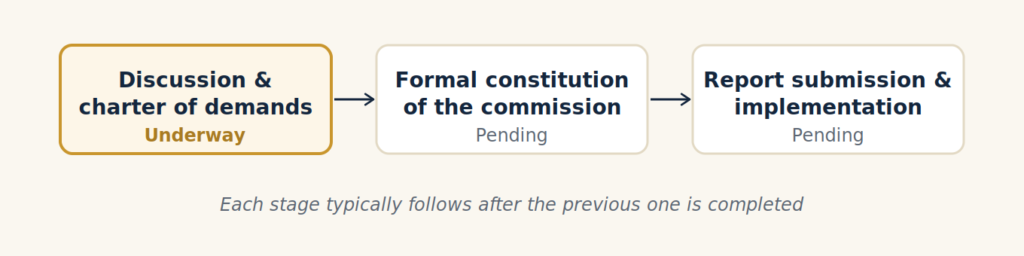
Step 1: Discussion & Charter of Demands
Employee unions present formal demands and recommendations to the government — a stage that is already underway.
Step 2: Formal Constitution of the Commission
This involves the government officially appointing a chairperson and members, along with defining the terms of reference. This step is currently pending.
Step 3: Report Submission & Implementation
Once constituted, the commission studies pay structures, consults stakeholders, and submits its report. A formal notification usually follows after the government reviews the recommendations.
Impact on Pensioners
Pay commissions don’t just affect serving employees — pensioners are usually covered too. In previous cycles, revised pension calculations followed the same fitment factor logic applied to basic pay. While specifics can vary each time, pensioners are generally expected to see a proportional revision once the 8th Pay Commission’s recommendations are implemented.
How to Stay Updated
Because much of this is still in the discussion stage, it’s worth following verified, regularly updated sources rather than relying on rumors or unofficial forwards. Bookmark this page and check back often — we update our coverage as soon as credible information becomes available.
Frequently Asked Questions (FAQs)
When will the 8th Pay Commission be implemented?
No official date has been announced yet. Based on past patterns, implementation typically follows a few years after formal constitution, but this remains speculative until the government makes an announcement.
What is the expected fitment factor for the 8th Pay Commission?
Estimates currently being discussed range between 2.57 and 2.86, but no official figure has been confirmed by the government.
Will pensioners benefit from the 8th Pay Commission?
Historically, pension revisions have accompanied pay commission implementations. While details vary each time, pensioners are generally expected to see updated benefits.
Has the 8th Pay Commission been officially constituted?
Not yet. As of this update, the government’s position on forming the commission is still awaited.
Where can I calculate my estimated revised salary?
You can use our Salary Calculator to get an illustrative estimate based on different fitment factor scenarios.
Disclaimer: This article is based on publicly available discussions and illustrative estimates. It does not represent official government data. For confirmed information, please refer to official Government of India notifications.